
Inside The Content Creation Casino
Most of what creators post earns almost nothing. A few posts pay for everything. Those are slot machine odds, and they are a feature, not a bug.
Most of what creators post earns almost nothing. A few posts pay for everything. Those are slot machine odds, and they are a feature, not a bug: they explain why creators keep pulling the lever, why brands keep buying in, and why even Google is rebuilding itself around the game.
Twelve hours. That is how long it took for Connor DeWolfe‘s life to change. He posted a video about ADHD, went to sleep, and woke up to something he did not see coming. “There was just a flood of comments, people saying they wanted ‘follow the dopamine’ on a shirt,” he recalls. A merch business materialized out of a single upload. This is the jackpot, the moment that pays for all the ones that missed, the story every creator has heard some version of: the right video, the right night, that elusive viral magic where the notifications stack faster than the screen can load them, the direct messages and comments and likes pour in, and the timeline lights up in a way it never has before.
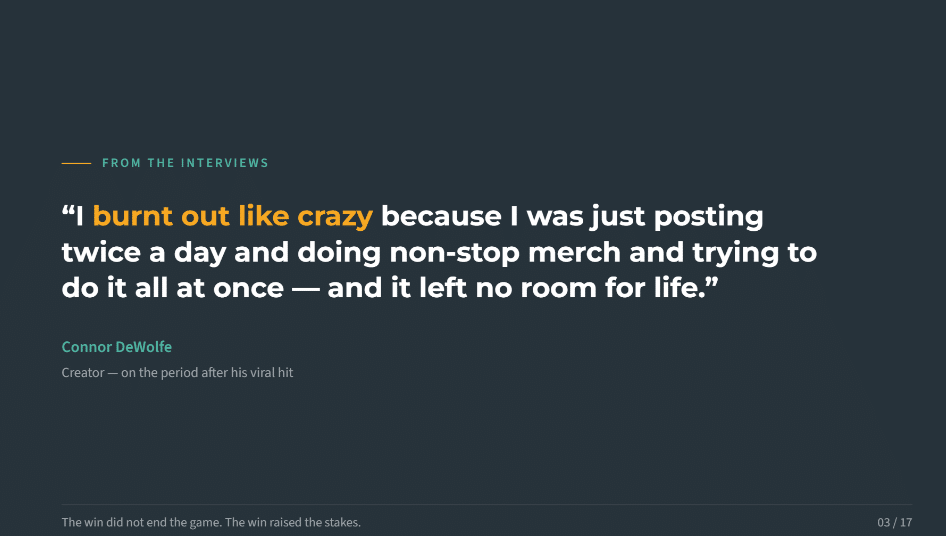
But like every emotional high, it drains as much as it lifts, and it leaves creators chasing the next one. “I burnt out like crazy because I was just posting twice a day and doing non stop merch and trying to do it all at once and it left no room for life,” DeWolfe says of the period that followed. The win did not end the game. The win raised the stakes.
Talk to enough people in the creator economy and the vocabulary converges on its own. It usually begins with luck. Lindsay Ivan still frames her breakout as a fluke: “I feel like I got lucky with that one video that brought in 50,000 followers. Nowadays, times have changed and it’s not like that anymore.” But luck is the easy part. What lingers is the itch to reproduce it, and Kaeya Majmundar, who parlayed her creator years into founding Sway ID, names that itch with unusual candor: “I was really just more obsessed with figuring out how to go viral again.” Enough people feel it, for long enough, and it hardens into a vocabulary. When we surveyed 77 industry professionals at the end of last year, the phrases that kept surfacing were “content creation treadmill,” “lottery ticket,” and “slot machine.” The industry did not borrow the casino metaphor from its critics. The industry coined it about itself.
The story could end here: the house always wins, the creator cannot leave. But that picture explains the feeling, not the economics. Casinos run on variable rewards because they are profitable for the operator. The content casino runs on them for a different reason: variable rewards are the only viable way to create inventory that spoils in hours.
The Half-Life Problem
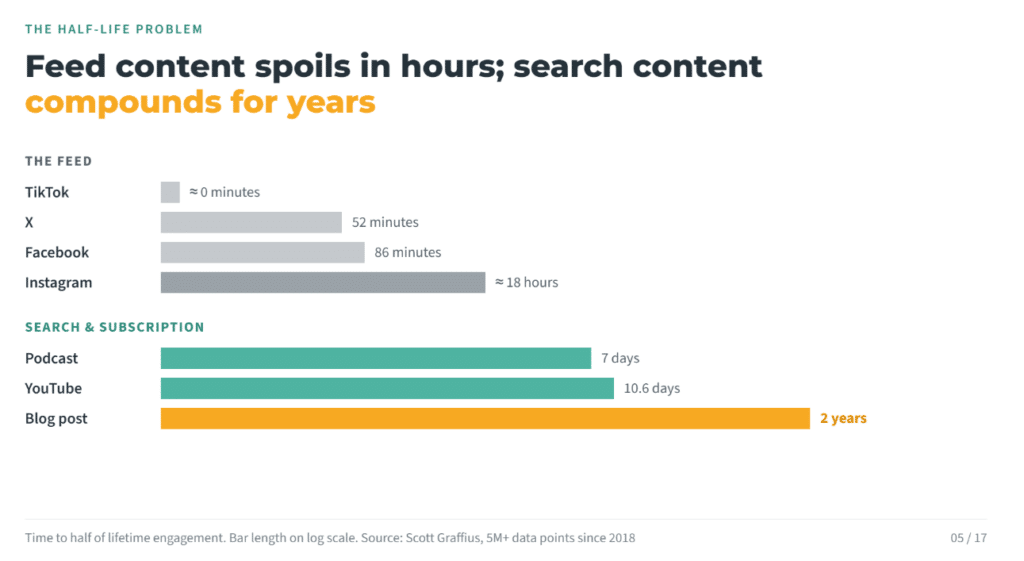
Scott Graffius has tracked the engagement half-life of social posts across more than five million data points since 2018, and the numbers are brutal. A post on X earns half of its total lifetime engagement within 52 minutes. On Facebook, 86 minutes. On Instagram, about 18 hours. On TikTok, the average half-life rounds to zero minutes: the platform moves so fast that a typical video captures half of everything it will ever earn more or less instantly, then falls off a cliff.
At the other end of the same table, a podcast episode reaches its half-life in seven days. A YouTube video, 10.6 days. A blog post, two years. That spread is the central economic fact of the attention economy: content optimized for the feed decays in minutes to hours, while content indexed for search and subscription compounds for days to years.
Creators feel that difference in their own work every day. “Short form content is much more difficult to have a long kind of value tail to it,” Will Hanisch of Green Room shares. “Long form content, while it may not be as viral in certain moments, has that longer term value.” Brandon Pleshek, the cleaning creator behind Clean That Up, makes the same video more than once. His clip on cleaning fan blades with a pillowcase is not something he can resurface when interest comes back around. He reshoots the concept from scratch every so often and posts it again as a new upload. “It doesn’t live forever like a YouTube video,” he says. The original has already spent its value, so the only way to earn from the idea again is to make it again.
The House Pays in Lottery Tickets
The problem we mapped in June looks different from the platform’s side of the table. You operate a feed that must be refreshed constantly for billions of users, each of whom expects an infinite stream of content matched to their particular interests. Hiring that production is impossible. No studio system in history has produced at feed velocity, and no payroll could survive the attempt. The solution the platforms converged on is elegant: crowdsource the production, and pay for it in distribution rather than in wages.
Distribution is a currency the platform mints at zero cost, and it pays out on a variable schedule. Upload a video and the feed tests it on a small audience. Hold attention and the test expands. Fail and the video dies quietly. Tristan Rhee of LaunchPoint describes the promise at the heart of the system: “If someone has 100,000 followers and someone has a thousand followers, and both of them are making the same quality of content, they both have equal chances of going viral.” Anyone can win. That is precisely how the house fills its seats.
The payouts distribute like lottery tickets, not like wages. Seth Girsky of Word on the Block puts a number on the shape: “75, 80, 90 percent of the creators are making less than $20,000.” A few videos capture most of the distribution a platform has to hand out, and the long tail earns close to nothing, the shape every variable-reward payout takes when you chart it.
What variable payouts do to a business is turn planning into prayer. “The revenue fluctuations for a creator are quite strong,” Danielle Pederson of Amaze observes. “Some months they have a lot of brand deals and some they might not.” Eric Wei, whose company Carrot Financial exists precisely because creator income is volatile, frames the question every creator eventually asks: “What happens when the algorithm changes and the views stop coming in? How do I make money?”
The Treadmill
The algorithm does not only reward output. It punishes absence.
“These algorithms force creators to constantly be putting out content every single day,” Jake Webb of Slash explains, connecting the cadence requirement to what he calls creator plateauing: a structural condition, not a talent problem. Mat Micheli of Viral Nation describes what happens to those who step away: “Once they just don’t post anymore, followers will forget you very quickly, unfortunately. And that is probably one of the worst things creators can do.” One creator says that “even being one week off... you’ll see a decline in your income,” which means the algorithm charges rent on rest.
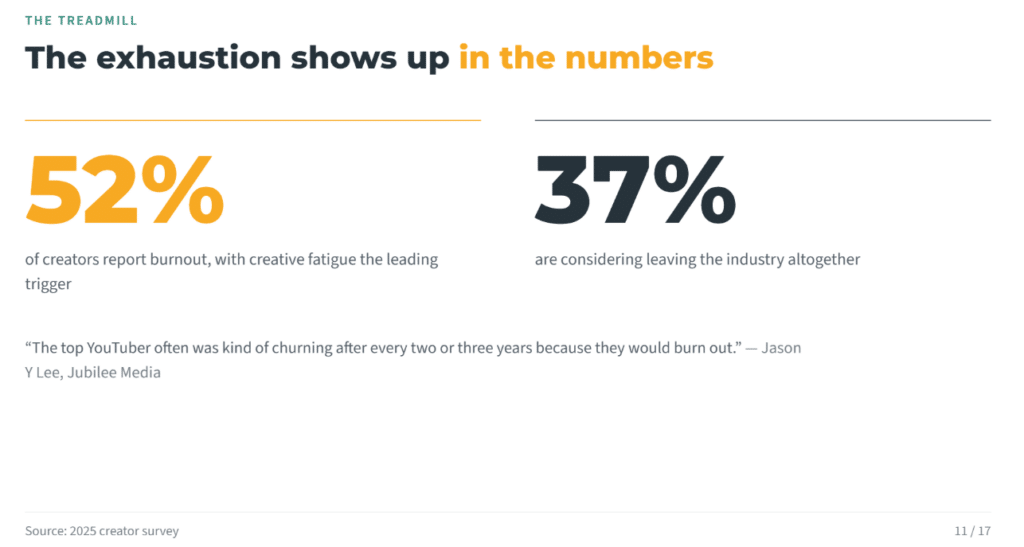
The exhaustion shows up in the numbers. A 2025 survey found 52 percent of creators reporting burnout and 37 percent considering leaving the industry, with creative fatigue the leading trigger. Jason Y Lee of Jubilee Media has watched the cycle long enough to see it as generational churn: “The top YouTuber often was kind of churning after every two or three years because they would burn out.”
The Whales at the Table
Brands looked at this attention casino and drew two conclusions. They cannot sit out, because the feed is where their customers’ attention lives. And they cannot fill it themselves, because the feed demands a kind of production they are structurally unable to perform.
The gap is not talent or budget. The gap is that interest content must be manufactured at a scale, breadth, depth, and frequency that no marketing department can sustain. Scale, because the half-life data means a brand’s content inventory evaporates daily. Breadth, because the interest graph has shattered the audience into thousands of micro-contexts, and a brand can be native to perhaps one of them. Depth, because attention earned through a person carries trust that attention bought by a logo does not. And frequency, because the same treadmill that exhausts creators operates on brand accounts as creative fatigue, burning out ad creative in days.
Money, however, is the one resource brands like Unilever, Nike, and Sephora hold in abundance, and so the attention economy settled into its core transaction: the exchange of money, which brands have and cannot convert on their own, for attention, which creators can manufacture and cannot bank. “We are just watching budget move towards creator led content,” Andy Cloyd of Super Affiliate reports. Scott Sutton of Later sees the migration reaching well beyond social line items: “Even their linear TV budgets, their CTV budgets, their display ads are leveraging creators more and more.”
Could brands simply build the factory in-house? The market has run that experiment. Marketers increased spending on AI-generated content by 79 percent in a bid to manufacture interest content directly, even as consumer preference for AI content collapsed from 60 percent to 26 percent. Money bought volume. It did not buy attention. Jennifer Quigley-Jones of Digital Voices explains why the creators keep winning the comparison: “Creators often speak better to customers than the brands themselves. That psychological shift of letting go of control has transformed the industry. I think we’re probably 20 percent into that journey.”
Everyone Is in the Attention Business
Every entertainment company, video game studio, streaming service, and digital platform is competing for the same finite pool of human attention. In that contest, the social platforms hold a structural advantage no studio can match: they crowdsource their production. Netflix must finance every hour of programming it streams. TikTok’s programming finances itself, lured into existence by lottery tickets, refreshed daily by millions of unsalaried producers. It is the difference between a theater that pays its performers and a casino whose patrons put on the show.
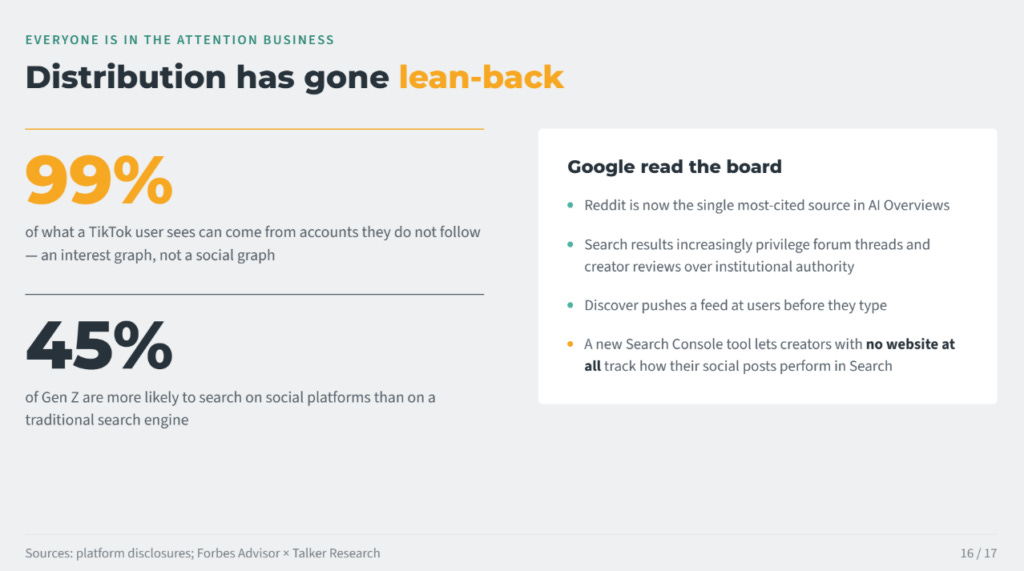
The advantage compounds because of a second shift: distribution has gone lean-back. For two decades, the search engine was the counterweight to the feed, a place where content was pulled by intent rather than pushed by prediction, and where a well-made page could earn traffic for years. “Before, we kind of relied on Google search as a constant reliable source of traffic,” recalls Raymond Cua of Traveling Foodie, “compared to social media where it’s like, oh, we don’t know what the algorithm does.” That reliability is dissolving. The recommendation engines have become so good that entertainment increasingly arrives before anyone asks for it. On TikTok, as much as 99 percent of what a user sees comes from accounts they do not follow, a feed ranked by an interest graph rather than a social graph. It is driven by behavior rather than connections: the videos you finish, the topics you linger on, the intent you signal with every second of attention. The platforms stopped caring who you know. They care who you are.
Google, to its credit, read the board. Watch what the company has done rather than what it has said: Reddit is now the single most-cited source in AI Overviews. Search results increasingly privilege forum threads, creator reviews, and first-person perspective over institutional authority. Discover pushes a feed at users before they type. And this month, Google shipped a Search Console tool for creators that lets someone with no website at all track how their Instagram, TikTok, and YouTube posts perform in Search, a product decision that quietly concedes where content production now lives.
Stevie Johnson of Disrupt describes the direction of travel: platforms of every kind are “designed to predict our preferences rather than challenge them.” A study by Forbes Advisor and Talker Research found 45 percent of Gen Z more likely to search on social platforms than on a traditional search engine. The librarian is becoming a recommender, because the recommenders are winning, and the recommenders are winning because crowdsourced interest content is the cheapest attention ever manufactured.
Winners and Losers
Rewards that land at random, a treadmill that charges rent on rest, brands trading the money they hold for the attention they cannot make, and every distribution channel on the internet converging on the same lean-back, interest-ranked design. Step back from all of it and the pattern is unmistakable: very few players, beyond the platforms, are playing for keeps.
No one producing gets to rest. The creator posts through burnout because a week away shows up in next month’s income. The brand cycles through ad creative in days because its own posts spoil on the same schedule. There is no back catalog to coast on, and the value lives in the refresh, so it pays only while the refresh continues. The platform is the exception. It does not make the content that spoils. It owns the shelf everyone else is racing to restock, and what accumulates there, the audience, the ranking data, the advertiser relationships, does not spoil at all.
An economy built on products that last would slow down once it had enough. This one never has enough. The shelf is bare again by morning, and the creator and the brand wake up and start posting, chasing the outcome MrBeast and Fashion Nova already banked. The platform only has to open the doors.